
Despite the aid measures introduced by the government, many companies continue to deplore a drop, or even a total loss, in their turnover since 2020. Faced with the impossibility of ensuring sustainable economic activity, some managers find themselves against the wall forced to consider the dismissal of one or more employee(s). In this article, the LEGALPROTECH-AVOCATS firm provides you with some clarifications on economic dismissal, its conditions, its procedure and the obligations it underlies.
What is economic redundancy?
Economic dismissal is a dismissal carried out by the employer for one or more reasons not inherent to the person of the employee. Indeed, unlike dismissal for personal reasons (e.g. for misconduct), economic dismissal must only relate to the situation of the company and can result from one and/or other of the following circumstances:
| 1 | Economic difficulties of the company characterized either by the significant evolution of at least one economic indicator, such as a drop in turnover, operating losses or a deterioration in cash flow, gross operating surplus, etc. |
| 2 | Technological changes; |
| 3 | A reorganization of the company necessary to safeguard its competitiveness; |
| 4 | The cessation of its activity. |
As the law does not establish an exhaustive list of reasons for justifying redundancy, the financial difficulties of a company are subject to interpretation and must be studied on a case-by-case basis.
In a post-covid context, it will always be important to assess these based on the capabilities of the company and the difficulties encountered by other companies in the same sector of activity.
In the context of a deterioration in cash flow, the following case law examples can be cited:
- The deterioration of revenues due to the effect of the reduction of public funds and requests for studies impacting both the results and the cash flow of an association (Court of Appeal, Nîmes, 5th social chamber, September 10, 2019 – n° 17/00769);
- The balance sheet of accounts which reveals that the only operating income comes from subsidies which have decreased over time, that expenses are very unbalanced in relation to inflows and especially those representing salary costs which place a very heavy burden on the budget (Court of Appeal, Pau, Social Chamber, January 5, 2017 – No. 14/02207);
- The evolution of the financial results over several years, which demonstrate that the operating result is in deficit and continues to increase, that equity is decreasing, that resources are also decreasing in view of the drop in use of the services offered (Court of Appeal, Aix-en-Provence, Chamber 4-3, December 18, 2020 – No. 17/13894).
When it comes to a “decrease in turnover”, the Labor Code specifies that for a company:
- Fewer than 11 employees: a drop equivalent to one quarter constitutes an economic difficulty;
- From 11 to 50 employees: a drop of 2 consecutive quarters constitutes an economic difficulty;
- From 50 to 300 employees: a drop of 3 consecutive quarters is necessary to prove economic difficulty;
- More than 300 employees: a drop of 4 consecutive quarters constitutes an economic difficulty.
The dismissal is thus justified due to the significant drop in orders or turnover, which constitute a source of serious economic difficulties for the company.
If the economic reason is contested, the employee may refer the matter to the Industrial Tribunal within 12 months of his or her dismissal; the president of the Industrial Court being the only person competent to decide the real and serious nature of the company’s economic difficulties.
An informed employer will therefore guard against this eventuality by verifying the reality of the economic reason through the examination of the balance sheets and other accounting situations communicated by its accountant, prior to the implementation of economic dismissal. On this last point, it should be noted that the reality of the economic difficulties must in any case be assessed by taking into account the government aid received by the employer in the context of the health crisis.

The Court of Appeal in fact recalled in 2021 that a company which carries out its activity in the events sector, whose employer cites a situation strongly impacted by the health crisis, which produces various accounting documents revealing a significant drop in turnover, but which fails to produce information on the aid it was able to receive or on the guaranteed loans to which it was able to subscribe does not justify the manifestly excessive risks which it is claiming (CA Paris, March 4, 2021, no. 20/15164).
In the event that the employer is not able to establish a serious economic difficulty, he will be able to validly mobilize another economic reason for dismissal such as the reorganization of the company, as long as he will be able to justify that this is necessary to safeguard its competitiveness.
As a last resort, the employer can claim the cessation of activity of his company.
In this regard, case law considers that this circumstance can only justify an economic dismissal provided that it is not due to a fault on the part of the employer or to its reprehensible carelessness (Cass. Soc. Jan. 16, 2001 no. 98-44647).
To be admitted, the cessation of activity must be definitive; a temporary closure of the business which cannot characterize a cessation of activity.
What are the prerequisites for dismissal for economic reasons?
If you intend to resort to dismissal due to the economic difficulties of your company (and not the total cessation of its activity), you must ensure that you are unable to:
- On the one hand, to offer some of your employees another position within your company or in other companies in the group of which it is a part;
- On the other hand, to offer training likely to help one or all employees acquire the skills necessary for their reclassification in another position.
The existence of a real and serious cause is subject to the demonstration of these two elements.
What is the redundancy procedure?
The classic rules of dismissal apply to all economic dismissals. Therefore, the interview prior to dismissal, the effects of the termination, the letter of dismissal as well as the notice of dismissal are all elements which will continue to apply in the context of economic dismissal.
As economic dismissal can affect a single employee (individual economic dismissal) or several employees (collective economic dismissal), the steps of the “small” dismissal procedure (understood as being that which can affect up to 9 employees) are summarized below.
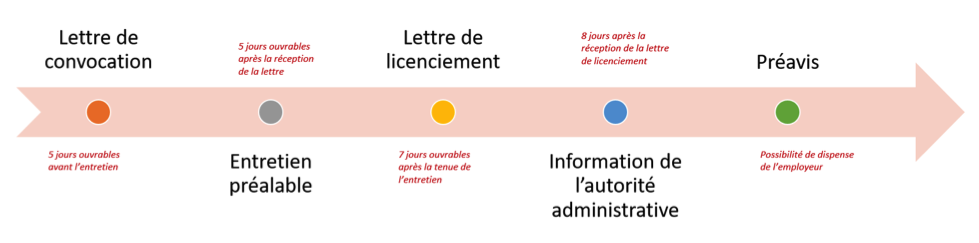
Please note, however, that the dismissal procedure can only concern employees hired in Cpermanent contract (CDI).
Indeed, Fixed-Term Contracts (CDD) and apprentice contracts respond to a separate procedure known as “early termination”, the economic and operational difficulties of a company not constituting a case of force majeure from a jurisprudential point of view (Cass. soc., April 28, 1986, n° 84-40.538 and Cass. soc., February 20, 1996, no. 93-42.663).
This type of dismissal occurs in a difficult situation to manage for both the employer and the employee, the LEGALPROTECH-AVOCATS firm will be able to support you in order to best manage this procedure and advise your company on all the solutions offered to it.
By Daniella TSHEFU
Article published on November 30, 2021. Its content reflects the context of its publication.
A question about your situation? Contact the firm ↗