You own real estate. Have you created or are considering creating a Real Estate Company (SCI) in order to anticipate issues related to the transfer of your real estate assets?
Have you thought about dismantling the shares of your SCI?
Implemented correctly and in advance, the dismemberment of shares in an SCI is an effective tax optimization tool which makes it possible to transfer real estate assets, while retaining the management or the income it generates.
What is property stripping?
Under the terms of article 544 of the Civil Code, ownership of real estate presupposes : the enjoyment of the good and the disposition of the property.
When a person has full ownership of a property, they have all the rights to a property.
Dismemberment consists of separating these rights into two parts:
- The usufruct which corresponds to the enjoyment of the property and;
- Bare ownership which corresponds to the disposition of the property.
Upon the death of the usufructuary (in our examples the parent or spouse), the bare owner (in our examples, the descendant or the surviving spouse) regains full ownership of the property.
Tax advantages
The transfer scheme consists in particular of parents bringing the real estate property(ies) they own to an SCI, then giving their children bare ownership of the shares in the SCI.
This will have the effect of reducing gift taxes, then inheritance taxes.
Indeed, the tax value of the bare ownership of the SCI shares depends on the age of the usufructuary and is calculated as follows (article 669 of the General Tax Code):
| Age of the usufructuary | Value of the usufruct | Value of bare ownership |
| Under 21 | 90% | 10% |
| From 21 to 30 years old | 80% | 20% |
| From 31 to 40 years old | 70% | 30% |
| From 41 to 50 years old | 60% | 40% |
| From 51 to 60 years old | 50% | 50% |
| From 61 to 70 years old | 40% | 60% |
| From 71 to 80 years old | 30% | 70% |
| From 81 to 90 years old | 20% | 80% |
| From age 91 | 10% | 90% |
Thus, the earlier the donation of bare ownership is made, the more the tax value of the donation is reduced.
Let’s take the example of a 68-year-old person wishing to pass on their family home worth €200,000 to their two children.
Without dismemberment
The amount of rights will amount to approximately €18,194 per child, for a total of €36,388.
With dismemberment
The value of the bare ownership will be calculated as follows: €200,000 * 60% = €120,000.
Gift tax will then be calculated on the basis of €120,000 and no longer €200,000 (assuming that no other reduction is applicable). The amount of rights will then amount to €10,194 per child, making a total of €20,388.
In comparison, in the case of a person aged 47, the gift tax will be calculated on the basis of €80,000 (assuming, again, that no other deduction is applicable). The amount of rights will then amount to €6,194 per child, making a total of €12,388.
Finally, upon the death of the parents, the children obtain full ownership of the shares of the SCI without having to pay additional inheritance tax because the combination of usufruct and bare ownership occurs automatically and tax-free.
Legal advantages
The division of the shares of the SCI allows the parents to keep the income, namely the dividends which correspond to the difference between the costs of the property and its income (rent).
In principle, it is bare-owner children who will have the right to vote at general meetings. However, it is possible to provide for a different organization in the statutes, in particular offering equivalent voting rights to parents and children.
In the presence of a cohabiting couple (unmarried) wishing to purchase a main residence, there is also another scheme in which dismemberment presents significant legal advantages: this is the technique known as cross dismemberment. Each person transfers the usufruct of their shares to their partner.
Let’s take an example: a couple, Greg and Sandrine, create an SCI which has 100 shares. Following the cross-dismemberment, the shares will be distributed as follows:
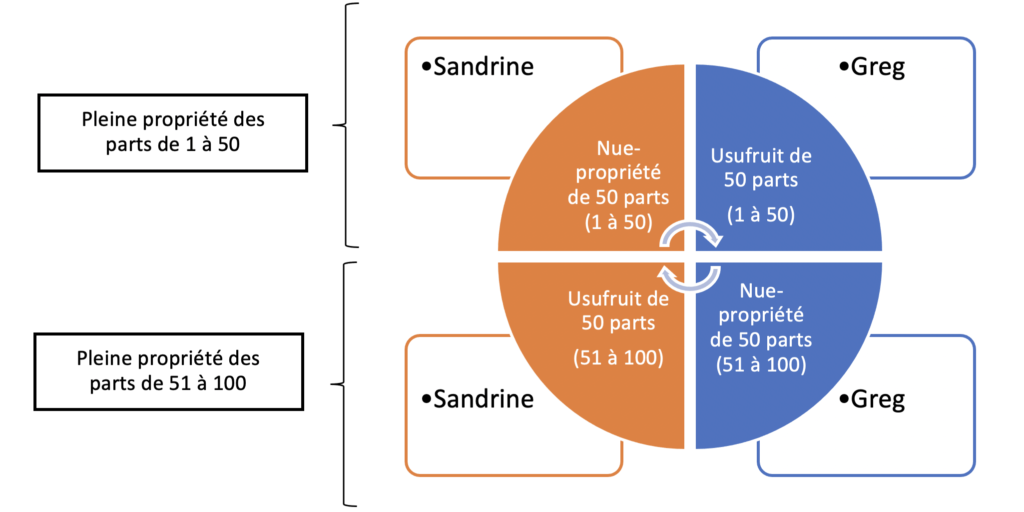
Upon Greg’s death, Sandrine will be able to retain full enjoyment of the real estate because she already has bare ownership of the 50 shares numbered from 1 to 50 and will receive the usufruct of Greg’s 50 shares numbered from 1 to 50.
Concerning Greg’s heirs, they will recover half of the shares in bare ownership, namely the shares numbered from 51 to 100.
Upon the death of Sandrine, Greg’s heirs will regain full ownership of the shares numbered from 51 to 100.
Conclusion
Dismemberment remains a particularly interesting legal technique in terms of transfer. However, it lies on the moving border between tax optimization and the desire to evade taxes.
This boundary is sometimes thin and respect for legal and tax rules, as well as professional drafting of the SCI’s statutes, make it possible to avoid being classified as an abuse of rights.
The LegalProTech firm supports you on these subjects in order to protect you from legal and tax risks.
Article published on June 24, 2021. Its content reflects the context of its publication.
A question about your situation? Contact the firm ↗