
Are you a business manager or a potential investor and you wish to structure your investments, buy a company or anticipate the transfer of your assets? Creating a holding company could be the solution you are looking for.
What is a holding company?
A holding company is a “classic” company: it is not a particular legal form. Indeed, it can be constituted in the form of an SARL, SAS or partnership. On the other hand, its particularity is to hold securities of other companies which are then qualified as subsidiaries.
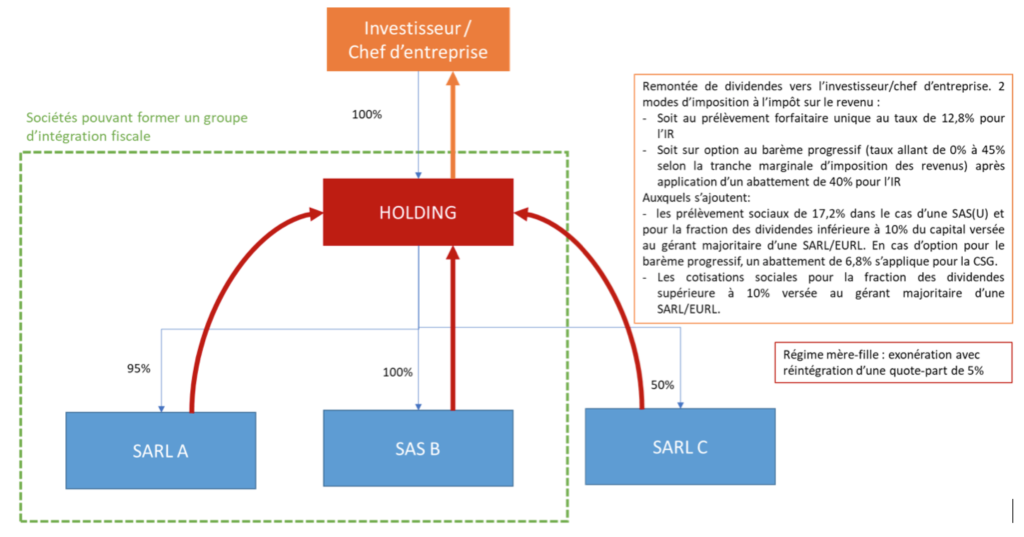
As an investor or business manager, the creation of a holding company can meet three main objectives:
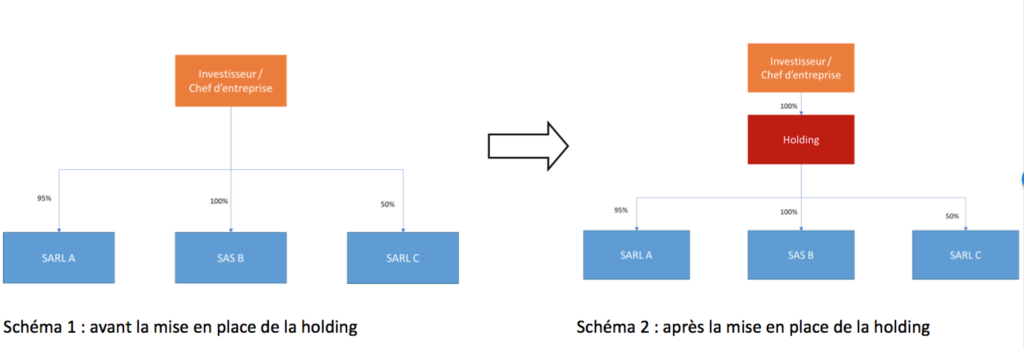
- Structuring or restructuring its holdings;
- Buy a company;
- Prepare the transfer of your company
Structuring or restructuring your holdings
This objective is aimed at business leaders and investors who hold or are intended to hold stakes in several companies having an economic activity.
On an operational level, the creation of a holding company makes it possible to establish a common policy between the different companies by determining the role of each company, rationalizing budgets and pooling services such as treasury, accounting or human resources at the level of the holding company. From a tax point of view, the creation of a holding company is particularly interesting. Indeed, under the so-called “mother-daughter” tax regime, and subject to meeting certain conditions, dividends paid by its subsidiaries are 95% exempt from tax.
Encrypted example
Let’s take the example of a dividend distribution by SAS B of €10,000.
| Diagram 1 – Without holding company (PFU option) | Diagram 2 – With holding (standard IS rate of 28%) | |
| Dividends | 10 000 € | 10 000 € |
| Taxable base | 10 000 € | 500 € |
| Tax on dividends | 1 280 € | 140 € |
| Amount remaining after tax (excluding contributions and/or social security contributions) | 8 720 € | 9 860 € |
Thus, in the event of distribution of dividends to the holding company in the amount of €10,000, the latter will be subject to a tax on the basis of €500 (in application of the 5% share of fees and charges), i.e. a tax of €140. In comparison, without the interposition of the holding company, the income tax liability will amount to €1,280, without taking into account deductions and social security contributions.
This regime can be associated with the so-called tax integration regime which makes it possible to tax the entire group at the level of the holding company, by offsetting the results of the subsidiaries – provided that the holding company holds at least 95% of the capital of its subsidiaries.
As a sole shareholder of the holding company, the investor or business manager has the possibility of keeping the dividends at the level of the holding company, if he considers that he does not need these funds or of distributing them to himself subject to taxation at the single flat-rate withholding of 30% (including 12.8% for income tax) or, optionally, at the progressive scale of income tax.
Encrypted example
| Diagram 1 – Without holding company | Diagram 2 – With holding | |
| Amount remaining after tax (excluding contributions and/or social security contributions) | 8 720 € | 9 860 € |
| Taxation of the return of dividends from the holding company to the single person partner (PFU option) | NA | 1 262€ |
| Amount received by the natural person partner | 8 720€ | 8 598€ |
Thus, in the event of interposition of the holding company, the amount received by the natural person partner is €8,598 whereas in the event of a direct reporting, without interposition, the amount received by the latter is €8,720. In other words, the interest of the holding company is less if the final objective is to have the cash generated by the activities of the subsidiaries. On the other hand, the creation of a holding company is of great interest if these dividends are then reinvested by the holding company in other activities (existing or new).
Buy a company
Creating a holding company to buy an operating company is an interesting investment plan in terms of financing and taxation.
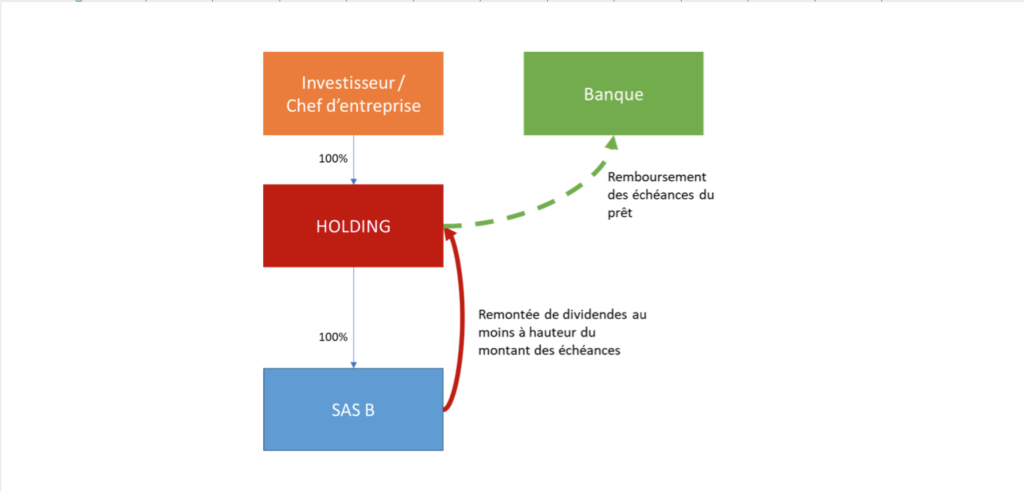
Indeed, in this scheme, the acquirer creates a holding company to which it contributes between 25% and 30% of the value of the target company. The balance is financed by a bank loan taken out by the holding company.
For example, if the target company is valued at 100,000 euros, the buyer can create a holding company with capital of €25,000 to €30,000 using its own funds. For the balance, the holding company will itself take out a loan of €70,000 – €75,000.
The maturities of the loan taken out by the holding company will be covered by the transfer of dividends from the target company, which has become a subsidiary, to the holding company. As explained above, dividends paid by a subsidiary benefit from particularly favorable tax treatment thanks to the parent-daughter regime and tax integration. In other words, the effectiveness of this arrangement relies on the ability of the target company to distribute sufficient dividends to cover the repayment of the loan taken out.
Prepare the transfer of your company
As a business manager or investor, it is important to anticipate the transfer of your assets. Indeed, a business manager may want one of his children to take over the helm of his business. Likewise, an investor can consider passing on the movable or real estate assets that he has built up.
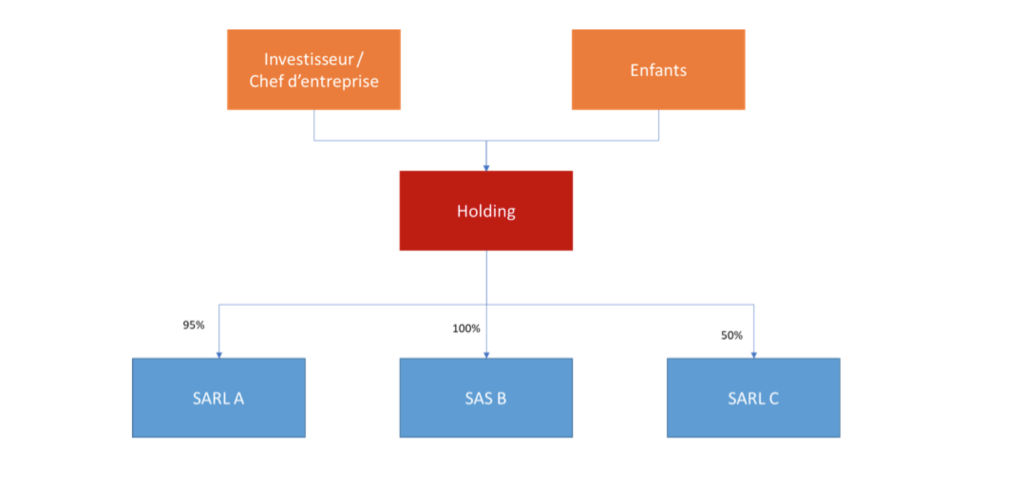
With this in mind, the holding company can prove to be a particularly effective transmission tool. One of the frequently used arrangements consists of making a donation-sharing (with or without usufruct reserve).[1]) of the securities of the holding company in order to integrate the heirs into the capital of the holding company.
In this arrangement, the holding company makes it possible to organize the distribution of powers through the statutes. So, for example, the business manager or investor can keep a minority share of the company’s capital while granting himself a right of veto to maintain his decision-making power.
On the other hand, it allows the transfer of securities within a favorable tax framework. Indeed, such a transfer can benefit from the “Dutreil” favorable tax regime, namely a reduction of 75% of the value of the securities transferred for the calculation of gift taxes. It should be noted, however, that this exemption regime only applies to so-called “facilitator” holding companies, that is to say those which participate in group policy and provide services to the group. The main constraint of this regime results from the conservation commitments to be made by the heirs, namely a collective commitment for a minimum period of 2 years followed by an individual commitment for a minimum period of 4 years by the person(s) taking over the company. Finally, the management function must be exercised by one of the people receiving the securities as a gift or inheritance.
[1] See our article on the dismemberment of shares to understand the donation-sharing mechanism with usufruct reserve: https://legalprotech.fr/le-demembrement-des-parts-dune-sci-familiale/
Conclusion
The holding company is a particularly interesting tool for a business manager or an investor. This arrangement presents significant advantages from a structural, financial and tax point of view. However, the creation of a holding company also presents risks, particularly from a legal, accounting and tax perspective:
- The management of the holding company and its subsidiaries requires legal legal practice both at the stage of setting up the holding company and at the level of its management, particularly when drafting intra-group agreements.
- The conditions of application of certain regimes (mother-daughter, tax integration, Dutreil pact) are particularly strict and must be studied to avoid any risk of challenge and tax adjustment.
- In certain cases, the holding company will have to establish consolidated accounts and appoint auditors so that they certify its accounts.
The LegalProTech firm supports you and offers you solutions adapted to your objectives, securing the legal and tax aspects.
Article published on September 4, 2021. Its content reflects the context of its publication.
A question about your situation? Contact the firm ↗